
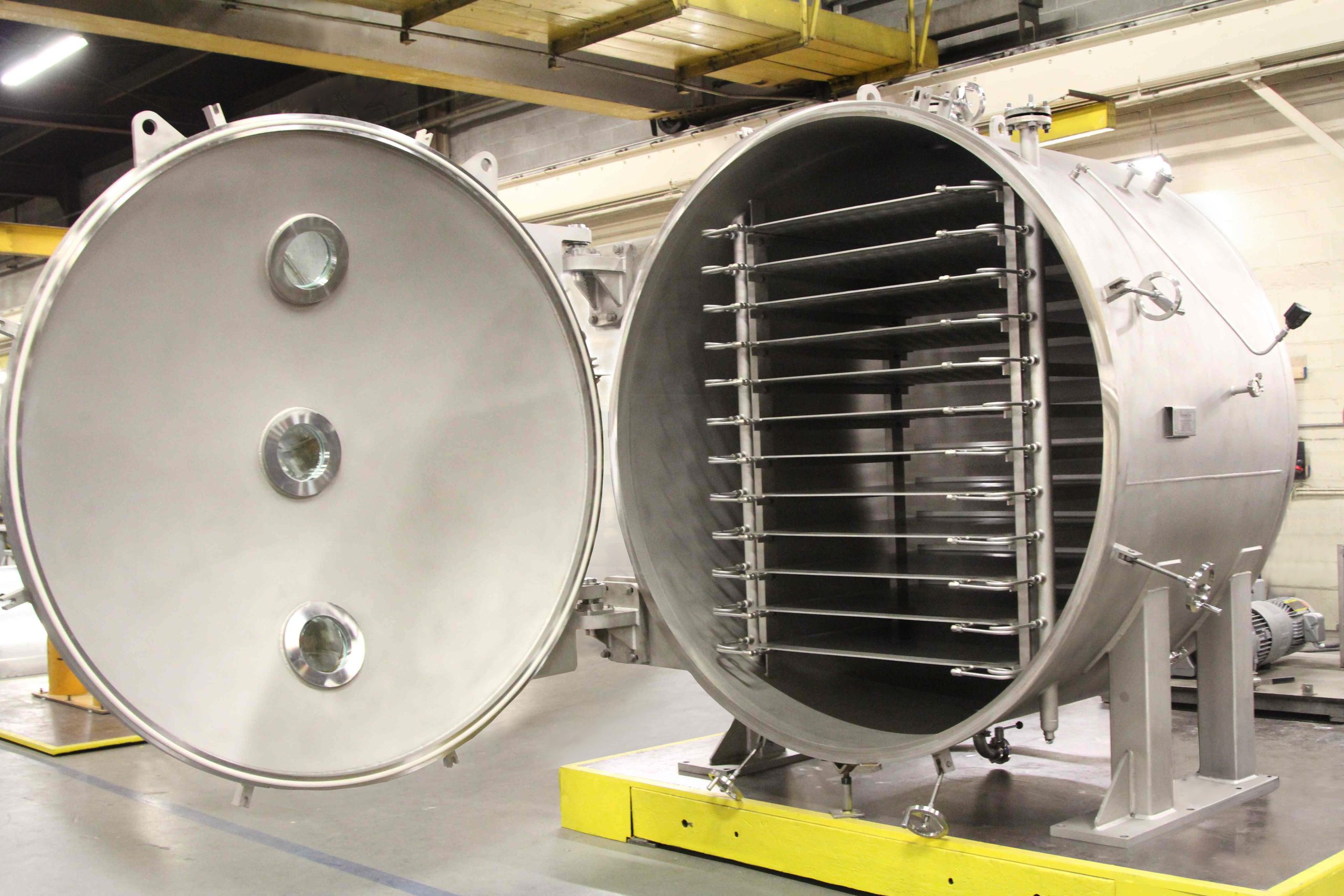
A vacuum shelf dryer removes moisture and solvent from a product held in trays on heated shelves inside a sealed vacuum chamber. Because the chamber is under vacuum, water and solvents evaporate at low temperatures. Because the shelves heat the product by conduction, nothing blows across or through it and nothing moves it. That combination makes the vacuum shelf dryer a strong choice for materials that cannot tolerate heat, oxygen, agitation, or compression.
Buflovak designs and manufactures vacuum shelf dryers with fixed, jacketed shelves in square or round chambers, customized to the process and pilot-tested before scale-up. This guide explains how they work, what they dry, and how they compare with hot-air tray drying methods, including through-circulation drying.
Quick Answers: Vacuum Shelf Dryers
| Question | Answer |
|---|---|
| What is it? | A batch dryer with heated shelves inside a vacuum chamber. Load the product in pans or trays and dry it with indirect heat under vacuum. |
| What makes it gentle? | Very low drying temperatures, no agitation, and no compression of the product |
| What does it dry? | Pharmaceuticals, nutraceuticals, vitamin extracts, specialty foods, fine chemicals, glandular products, and dyes |
| Can it recover solvents? | Yes. The vacuum environment supports capture and recovery of released solvents |
| Who uses it? | Pharmaceutical, nutraceutical, food, and chemical manufacturers with sensitive, high-value products |
How a Vacuum Shelf Dryer Works
The dryer is a square or round vacuum chamber containing fixed internal shelves. Each shelf has a flat top, and the underside carries a coil jacket that circulates a liquid heating medium or saturated steam for higher surface temperatures. The heating medium temperature sets the shelf temperature, which gives the operator precise control over how much heat reaches the product.
The process follows a simple sequence:
- Load wet material into pans or trays, then place them on the shelves.
- The chamber seals and is evacuated to the required vacuum.
- The heating medium circulates through the shelf jackets, and heat conducts through the shelf and tray into the product.
- Moisture and solvent evaporate at a reduced temperature because of the vacuum, and the vapor is drawn out of the chamber.
- Vapors are condensed so that valuable solvents can be recovered.
- When the product reaches its target dryness, the chamber is returned to atmospheric pressure, and the trays are removed.
The chamber size is driven by the shelf surface area the process needs. Shelf size, shelf spacing, and chamber geometry set the overall dimensions, and you can customize almost every aspect of the mechanical design and ancillary equipment.
Vacuum Shelf Drying vs. Through Circulation and Hot Air Tray Drying
People often search for through-circulation dryers when they need to dry granules or powders in trays without stirring. Buflovak does not build through circulation dryers, and the vacuum shelf dryer works on a different principle. It is the closest fit for the same kind of job, so it helps to see where the two differ.
| Feature | Through circulation or hot air tray dryer | Vacuum shelf dryer |
|---|---|---|
| Heat transfer | Heated air, forced across or through the product bed | Conduction from heated shelves (indirect heat) |
| Operating pressure | Atmospheric | Vacuum |
| Product exposure to air | Continuous flow of process air | None. The product is protected from oxidation and atmospheric contamination |
| Drying temperature | Set by hot air temperature | Very low, because vacuum lowers the boiling point of water and solvents |
| Solvent handling | Vapors leave in the exhaust air, which needs safe handling | Vapors are drawn out under vacuum and can be condensed and recovered |
| Product movement | Static bed | Static trays. No agitation or compression |
Airflow through a bed can move moisture quickly, so hot air methods suit granules that tolerate heat and air. The vacuum shelf dryer is the better choice when temperature, oxygen, or solvent recovery matters more than cycle speed. Batch drying time depends on the material, the solvent, and how deeply the trays are loaded, so confirm it with testing.
Benefits of Vacuum Shelf Dryers
- Low-temperature drying. Delicate, heat-sensitive materials dry safely at extremely low temperatures.
- Protection from oxidation. The vacuum keeps air away from the product, which helps protect oxygen-sensitive materials.
- Solvent recovery. The vacuum environment captures released solvents for reuse instead of venting them.
- Gentle handling. No agitation or compression means fragile particles, crystals, and structures stay intact.
- Precise temperature control. Jacketed shelves circulate steam or liquid at a controlled temperature.
- Purity. A sealed chamber limits contamination and protects the dried product’s integrity.
- Custom configuration. Square or round chambers, standard or custom sizes, and tailored ancillary equipment.
What Vacuum Shelf Dryers Are Used For
Buflovak’s product page lists these sample applications:
- Pharmaceuticals and antibiotics
- Vitamin extracts and nutraceuticals
- Glandular products and pepsin
- Fine chemicals and dyes
- Specialty food products
In pharmaceutical processing, the site points to vacuum shelf and pan dryers for heat- or solvent-sensitive APIs and excipients. See how they fit into a full process on the pharmaceutical processing page, or review the food and beverage applications for specialty ingredients.
Cleanability, Containment, and Integration
Pharmaceutical and nutraceutical buyers need equipment that is easy to clean and does not cross-contaminate batches. Buflovak builds closed vacuum systems with sanitary or containment-grade materials, smooth internal surfaces, and CIP- or SIP-ready design when required. Vacuum shelf dryers can be integrated with upstream and downstream steps such as filtration units, solvent recovery loops, containment systems, and milling or blending.
Testing and Scale-Up
The vast majority of Buflovak vacuum shelf dryers are installed on a production-guaranteed basis. Buflovak first tested and pilot-ran the specific process in its laboratory, providing reliable scale-up data for the right dryer configuration and working capacity. Buflovak’s Research and Test Center in Tonawanda, NY offers pilot-scale testing, CPEG’s Innovation Center and Testing Lab in Louisville, KY supports multistep processing, and lab rentals are available when on-site testing isn’t practical. Learn more about lab testing.
When a Vacuum Shelf Dryer Is Not the Right Fit
A vacuum shelf dryer is a batch machine, and operators load product into trays and manually place them on the shelves. That suits small to mid-size runs of high-value, sensitive material. Other Buflovak equipment fits other needs:
- Materials that need mixing while they dry, such as filter cakes, wet cakes, and wet powders that can be agitated during the drying process, can be batch dried with the Vacuum Rotary Dryer, the Vacuum Pan Dryer, or the PK Blenders’ Vacuum Tumble Dryer
- Liquids, slurries, and pastes that can be compressed during the drying process can be continuously dried with the Vacuum Double Drum Dryer.
Buflovak engineers can help match the material and the volume to the right dryer.
Frequently Asked Questions About Vacuum Shelf Dryers
How does a vacuum shelf dryer work?
Material is placed on heated shelves inside a vacuum chamber. Heat transfers indirectly from the shelf into the product while moisture and solvent are removed under vacuum.
Why are vacuum shelf dryers used for sensitive materials?
They dry at very low temperatures, preventing degradation and preserving product integrity. The vacuum also protects the product from oxidation and atmospheric contamination.
What applications are best suited to vacuum shelf dryers?
They are ideal for pharmaceuticals, nutraceuticals, vitamin extracts, specialty foods, and fine chemicals that need low-temperature drying without agitation.
Can solvents be recovered during drying?
Yes. The vacuum environment allows efficient solvent capture and recovery during drying.
What is the difference between a vacuum shelf dryer and a through circulation dryer?
A through circulation dryer forces heated air through the product bed at atmospheric pressure. A vacuum shelf dryer heats the product by conduction from shelves under vacuum, with no airflow through the product. Buflovak builds vacuum shelf dryers, not through circulation dryers.
What are the key advantages of vacuum shelf dryers?
Precise temperature control, gentle drying, solvent recovery, and customizable configurations for specialized applications.
How do I know if a vacuum shelf dryer is right for my product?
Consider heat sensitivity, oxygen sensitivity, solvent content, whether the product can be agitated, and batch size. Then confirm with pilot testing. A Buflovak process engineer can review your material and recommend a configuration.
Talk to a Buflovak Process Engineer
Buflovak has more than 100 years of thermal processing experience and builds each vacuum shelf dryer around the material it will dry. To discuss your process, contact our engineering team, request a quote, or view the full Vacuum Shelf Dryer page.