

Why Understanding Crystallization Matters for Industrial Processing
How does crystallization work? At its core, crystallization is a separation process where dissolved molecules arrange themselves into a highly ordered, solid crystal structure. The process relies on a simple principle: most substances are more soluble in hot liquids than in cold ones. When you cool a hot, saturated solution, the dissolved solute can no longer remain in solution and forms pure crystals, leaving impurities behind in the liquid.
The basic crystallization process follows three key steps:
- Dissolve – Heat the solvent to dissolve the maximum amount of solute, creating a saturated solution
- Crystallize – Cool the solution slowly to allow pure crystals to form as solubility decreases
- Separate – Filter the solid crystals away from the remaining liquid (called “mother liquor”)
This neat technique has been used for centuries, from ancient salt production to modern pharmaceutical manufacturing. You see crystallization everywhere in nature – in snowflakes forming from water vapor, in the slow growth of geodes deep underground, and even when honey turns cloudy and grainy in your pantry.
In industrial settings, crystallization serves as both a purification method and a separation technique. Chemical plants use it to produce high-purity products. Pharmaceutical companies rely on it to create active ingredients with specific particle sizes. Food manufacturers depend on it for everything from table salt to refined sugar.
The beauty of crystallization lies in its selectivity. As crystals grow, they form a precise molecular lattice that accepts only molecules of the right size and shape. Impurities that don’t fit this pattern stay dissolved in the surrounding liquid, resulting in a remarkably pure solid product.
For process engineers and plant managers, understanding how crystallization works isn’t just academic – it’s essential for controlling product quality, optimizing yield, and troubleshooting production issues.
The Science Behind Crystallization: Key Principles
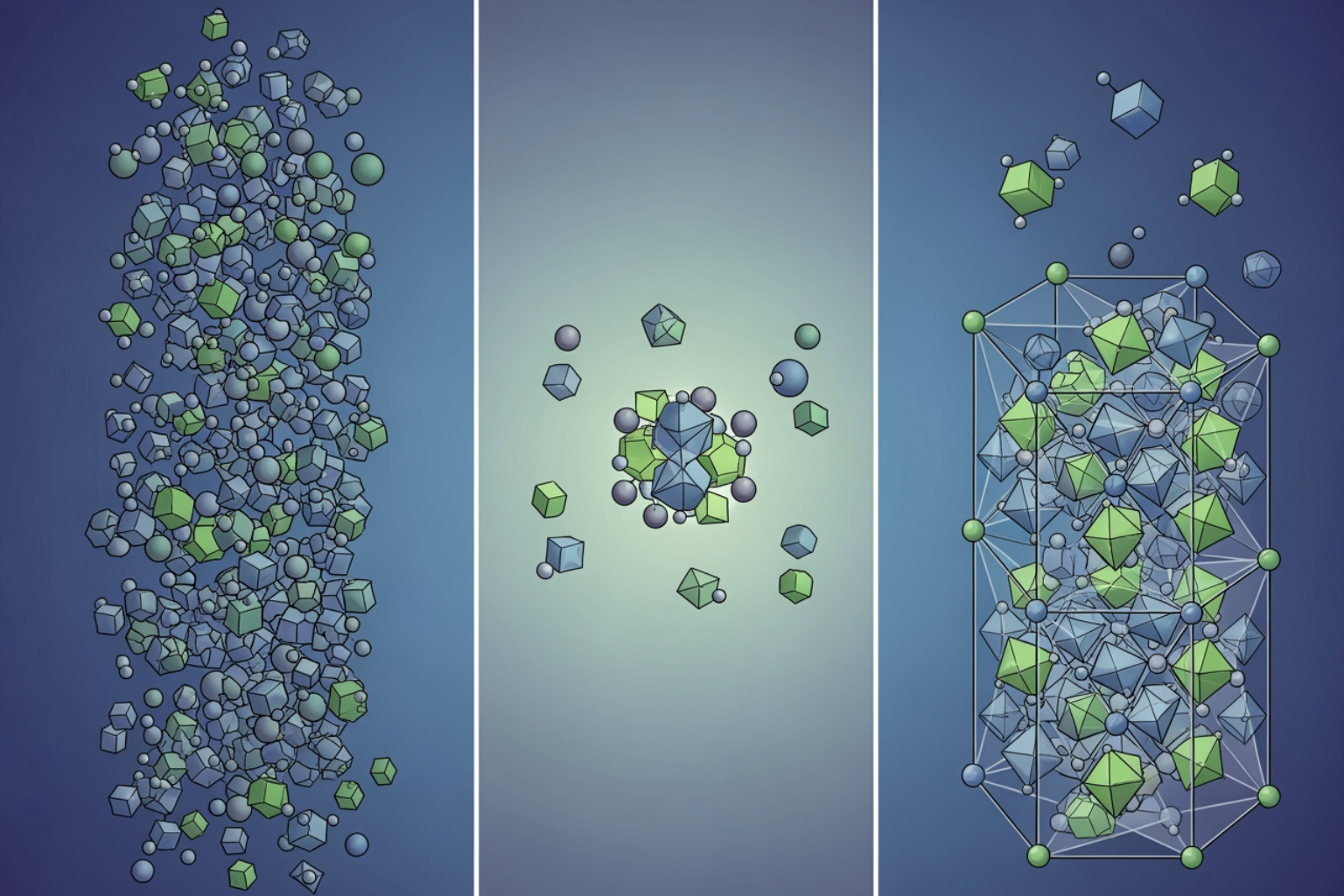
Think of crystallization as nature’s way of organizing chaos into perfect order. When dissolved molecules floating randomly in a solution suddenly arrange themselves into a precise, repeating pattern, you’re witnessing one of chemistry’s most neat changes. This phase change—from disordered liquid to organized solid—happens because the system naturally seeks its lowest energy state, like water flowing downhill.
This energy minimization creates the sturdy crystal lattice structures we see in everything from table salt to pharmaceutical compounds. Understanding these principles is essential for anyone working with industrial crystallization systems.
For a comprehensive visual explanation of these concepts, check out this helpful resource: Video: Crystal Growth: Principles of Crystallization
The Role of Solubility and Supersaturation
How does crystallization work at a fundamental level? It all starts with solubility—the maximum amount of a substance (the solute) that can dissolve in a liquid (the solvent) at a given temperature. Here’s the key insight: most compounds dissolve much better in hot liquids than cold ones. That temperature-dependent behavior is what makes crystallization possible.
When you’ve dissolved as much solute as possible at a particular temperature, you’ve created a saturated solution. The solvent is holding all it can. Now, imagine cooling that solution. As the temperature drops, the solubility decreases. Suddenly, your solvent is holding more dissolved material than it should at this new, cooler temperature.
This condition—where you have more dissolved solute than the equilibrium solubility allows—is called supersaturation. And supersaturation is absolutely essential. It’s the driving force that pushes dissolved molecules to leave the solution and form crystals.
Picture a crowded dance floor. Everyone has just enough room to move around comfortably. But if the room suddenly gets smaller, people naturally cluster together. Supersaturation works the same way. When the solution can’t hold all those dissolved molecules anymore, they’re forced to find each other and organize into solid crystals.
There’s also a sweet spot called the metastable zone—a range of supersaturation where existing crystals will grow happily, but new crystals won’t spontaneously appear. Skilled process engineers learn to work within this zone to control crystal size and quality.
You can create supersaturation in several ways beyond cooling. Evaporating the solvent concentrates the solution. Adding an anti-solvent (a liquid that reduces solubility) forces the solute out. Sometimes a chemical reaction produces a new compound that’s less soluble than its starting materials. Each method has its place depending on your specific process needs.
The Two-Step Formation: Nucleation and Crystal Growth
Crystals don’t just pop into existence fully formed. They’re built in two distinct stages: nucleation and crystal growth. Understanding both stages helps you control which crystals you’ll get.
Nucleation is the birth moment. A few dissolved molecules bump into each other in just the right way and stick together, forming a tiny cluster. This cluster—called a nucleus—is the foundation for everything that follows. It’s like the first few people who decide where to build a new city.
Getting nucleation started isn’t always easy. Molecules need enough supersaturation to overcome the energy barrier of forming something new. That’s why we distinguish between different types of nucleation.
Primary nucleation happens without any existing crystals around. Homogeneous nucleation occurs spontaneously in a perfectly clean solution—though it requires very high supersaturation and is actually pretty rare in real-world conditions. Much more common is heterogeneous nucleation, in which the first clusters form on surfaces such as dust particles, scratches on the container wall, or other tiny impurities. These surfaces act as helpful starting points, lowering the energy barrier.
Secondary nucleation takes over once you already have some crystals in your solution. Existing crystals can spawn new ones through collisions with one another, contact with vessel walls, or simply due to fluid shear forces. This is the workhorse of industrial crystallization—it happens at lower supersaturation levels and produces crystals much more reliably than primary nucleation.
Once you have stable nuclei, crystal growth begins. Additional molecules from the supersaturated solution land on the crystal surface. If they fit the crystal lattice’s geometric pattern, they stick. If not, they drift away. Layer by layer, the crystal expands in its characteristic shape.
The final appearance of your crystals—their crystal habit—depends on how fast they grow, what solvent you’re using, and what impurities might be present. Some conditions produce long needles. Others create chunky blocks or delicate plates. Both nucleation and growth continue simultaneously as long as supersaturation exists, and the balance between them determines your final crystal size and purity.
What is ‘Water of Crystallization’?
Here’s something fascinating: some substances trap water molecules inside their crystal structure as they form. This isn’t just moisture clinging to the surface—these stoichiometric water molecules are actually part of the crystal itself, bonded into the lattice in fixed, predictable ratios.
Take copper sulfate, a bright blue chemical you might remember from high school chemistry class. When it crystallizes from water, each unit of copper sulfate incorporates exactly five water molecules into its structure. The full name is copper(II) sulfate pentahydrate, written as CuSO₄·5H₂O. Those water molecules give the crystals their beautiful blue color, which is why it’s also called blue vitriol.
Heat these blue crystals gently, and something remarkable happens. As the water molecules leave, the blue color fades to white. What remains is the anhydrous form—copper sulfate without its water of crystallization. This dramatic color change makes it easy to see when hydrated crystals lose their water content.
Many salts and other compounds crystallize with water built into their structure. Understanding whether your product will contain water of crystallization matters for everything from product weight calculations to storage stability.
How Does Crystallization Work in Practice? A Step-by-Step Guide
Understanding the theory is one thing, but actually performing crystallization—whether you’re working in a laboratory in Louisville or scaling up a process in Tonawanda—requires careful attention to each step. Let’s walk through the practical side of how crystallization works when you’re actually doing it.
Step 1: Choosing the Right Solvent
If there’s one decision that can make or break your crystallization process, it’s picking the right solvent. We’ve seen countless batches saved or ruined based on this choice alone.
The ideal solvent follows what we like to call the “Goldilocks principle” for your target compound: it should dissolve your solute readily when hot, but barely touch it when cold. This dramatic difference in solubility creates the supersaturation we need for beautiful crystal formation. Think of it like this—you want to pack as much dissolved material as possible into a hot solvent, then pull the rug out from under it by cooling, forcing those molecules to come out of solution as pure crystals.
But there’s more to consider. Your impurities need to behave differently. Ideally, they should either stay completely dissolved even in cold solvent (so they remain in the mother liquor) or be totally insoluble in hot solvent (so you can filter them out before crystallization even begins). We definitely don’t want impurities deciding to crystallize alongside our product.
Here in the United States, whether you’re operating in New York or Kentucky, safety and environmental impact aren’t just nice-to-haves—they’re essential. We prioritize solvents with low toxicity, high flash points, and minimal environmental footprint. The cost and ease of disposal matter too, especially when you’re running industrial-scale operations.
Sometimes a single solvent just won’t cut it. That’s when we turn to mixed solvent systems—typically two miscible solvents where one dissolves the compound well and the other acts as an anti-solvent. It’s a bit like having a good cop and a bad cop working together to coax your product out of solution.
Finding the perfect solvent often takes some trial and error. We’ll test candidates by dissolving small amounts of the impure solid, heating it, and observing what happens on cooling. Published solubility data can point us in the right direction, but there’s no substitute for actual testing with your specific material.
Step 2: Dissolving the Solute
With our solvent selected, we move to the dissolution stage. This is where patience and precision really pay off.
The golden rule here is to use the minimum amount of hot solvent necessary to completely dissolve your impure solid. Why minimal? Because if you use too much solvent, even after cooling, a lot of your precious product will stay dissolved in the mother liquor instead of forming crystals. You’ll end up with a disappointing yield. Using just enough solvent also ensures you achieve a high degree of supersaturation upon cooling—and remember, supersaturation is the driving force that makes crystallization happen.
We heat the solvent to its boiling point and add it gradually to the solid, or vice versa, stirring constantly. As we approach the right amount, we’ll see the solid gradually disappear into solution. It’s satisfying to watch, honestly.
Here’s a safety tip that’s saved many a batch: preventing bumping. When you heat liquids, especially in laboratory glassware, you risk sudden, violent boiling that can splash hot solvent everywhere. Not fun. We prevent this by adding boiling chips or using a magnetic stir bar, which provide nucleation sites for smooth, controlled boiling. And if you’re working with flammable organic solvents—which is common in pharmaceutical and chemical applications—always use a steam bath or heating mantle rather than an open flame. Your safety officer will thank you.
If your impure starting material has colored impurities (and many do), this is the perfect time to deal with them. Once everything’s dissolved in hot solvent, we add a small amount of activated charcoal. Its incredibly porous surface acts like a molecular sponge, adsorbing those colored contaminants. After a few minutes of contact time, we filter off the charcoal while the solution is still hot, leaving us with a cleaner solution ready for crystallization.
Step 3: Inducing Crystallization
Now comes the moment of truth—getting those crystals to form. We have several techniques at our disposal, and choosing the right one depends on your specific compound and situation. Here’s how the main methods compare:
| Method | Principle | Best Use Cases | Pros & Cons |
|---|---|---|---|
| Cooling Crystallization | Lowering temperature reduces solubility, forcing solute out of solution as crystals | Compounds with strong temperature-dependent solubility; most common in labs and industry | Pros: Simple, controllable, excellent purity. Cons: Slower process; requires cooling infrastructure; doesn’t work well for compounds with flat solubility curves |
| Evaporative Crystallization | Removing solvent by heating increases solute concentration until supersaturation occurs | Compounds with relatively flat solubility curves; salt and sugar production | Pros: Effective when cooling won’t work; can handle high volumes. Cons: Energy-intensive; risk of thermal degradation; may produce smaller crystals |
| Anti-Solvent Crystallization | Adding a miscible non-solvent reduces overall solubility, triggering crystallization | Pharmaceuticals requiring precise particle size; heat-sensitive compounds | Pros: Works at constant temperature; rapid; good for sensitive materials. Cons: Requires compatible anti-solvent; can be harder to control; more complex operation |
Cooling crystallization is the workhorse method you’ll encounter most often. After dissolving your solid in a minimal amount of hot solvent, let the solution cool slowly for the best results. As the temperature drops, solubility plummets, and your solute has nowhere to go but into crystal form. We often set up a controlled cooling profile, starting fast at high temperatures where solubility is still decent, then slowing down as we approach the target temperature. This gives us the best balance of crystal size and purity.
Evaporative crystallization takes a different approach. Instead of cooling, we apply heat to evaporate the solvent, concentrating the solution until it can’t hold any more solute. This method shines in the food industry—think about how sugar and salt are produced at industrial scale. It’s also our go-to when dealing with compounds whose solubility doesn’t change much with temperature. The main challenge is managing energy input and ensuring we don’t overheat temperature-sensitive materials.
Anti-solvent crystallization is the sophisticated cousin of the family. Here, we add a second solvent (one that doesn’t dissolve our product well) to the saturated solution. As the anti-solvent mixes in, it reduces the overall solubility, forcing crystallization. This technique is particularly popular in pharmaceutical manufacturing because it allows precise control over particle size and can be performed at room temperature, protecting delicate active pharmaceutical ingredients from thermal stress.
Sometimes crystals form spontaneously as you cool or evaporate. Other times, the solution stubbornly stays supersaturated without nucleating—this is called being in the metastable zone. If this happens, we can encourage nucleation by scratching the inside of the flask with a glass rod, adding a seed crystal, or even just being patient. Once nucleation starts, crystal growth usually follows readily.
Step 4: Separating Crystals from the ‘Mother Liquor’
Once we’ve got beautiful crystals forming in our solution, we need to separate them from the remaining liquid—what we call the mother liquor. This saturated solution still contains dissolved impurities and some of our product, but the goal is to harvest the pure solid crystals we’ve worked so hard to grow.
Filtration is the standard separation technique. In the lab, we typically use vacuum filtration with a Buchner funnel and filter paper. The vacuum pulls the liquid through while the crystals stay behind on the filter. It’s fast and efficient. At an industrial scale, the equipment gets bigger and more sophisticated, but the principle remains the same—physical separation based on particle size.
Before we finish, there’s an important step many people skip: washing the crystals. Even after filtration, the crystal surface is coated with a thin film of mother liquor containing those dissolved impurities. We rinse the crystals with a small amount of ice-cold pure solvent. Cold is crucial here—we want to wash away surface impurities without redissolving our hard-won crystals. The chilled solvent dissolves far less of our product, so we maintain high yield while improving purity.
Finally, we need to dry the crystals thoroughly. Residual solvent can affect the product’s properties and stability. In the lab, we might spread crystals on a watch glass and let them air dry, or use a desiccator for faster results. Industrial operations employ specialized drying equipment—and here at Buflovak, we know a thing or two about efficient thermal drying systems that can handle this final step while maintaining product quality.
The entire process, from choosing a solvent to collecting dried crystals, requires attention to detail at every stage. But when you see those pure, well-formed crystals—whether it’s a few grams in a research lab or tons in a production facility—you know all that care was worth it. That’s how crystallization works in practice: a blend of science, technique, and a bit of art.