

Why FDA Regulations Matter in Pharmaceuticals
FDA regulations and pharmaceutical oversight are the foundation of drug safety and efficacy in the United States. If you’re a pharmaceutical manufacturer, understanding these regulations isn’t optional; it’s the price of entry into the market and the key to protecting public health.
Here’s what FDA pharmaceutical regulations cover:
- Drug safety and efficacy – Ensuring all pharmaceutical products are safe for use and deliver their intended therapeutic benefits
- Manufacturing standards – Current Good Manufacturing Practice (CGMP) requirements for facilities, equipment, and processes
- Clinical trials – Good Clinical Practice (GCP) standards and human subject protection
- Application processes – IND, NDA, ANDA, and BLA pathways for different drug types
- Post-market surveillance – Ongoing safety monitoring, adverse event reporting, and enforcement actions
- Labeling and promotion – Strict rules governing how drugs can be marketed and described
The stakes are high. By late 2019, the FDA-regulated products accounted for about one-fifth of all consumer spending in the United States. Between 1992 and 2014, eighteen drugs were withdrawn from the market after approval due to safety concerns. A 2017 JAMA study found that 71 out of 222 new drugs approved between 2001 and 2010 experienced significant safety problems after FDA approval.
For pharmaceutical manufacturers, navigating this complex regulatory landscape means understanding everything from the Federal Food, Drug, and Cosmetic Act to the specific sections of Title 21 of the Code of Federal Regulations governing their operations.
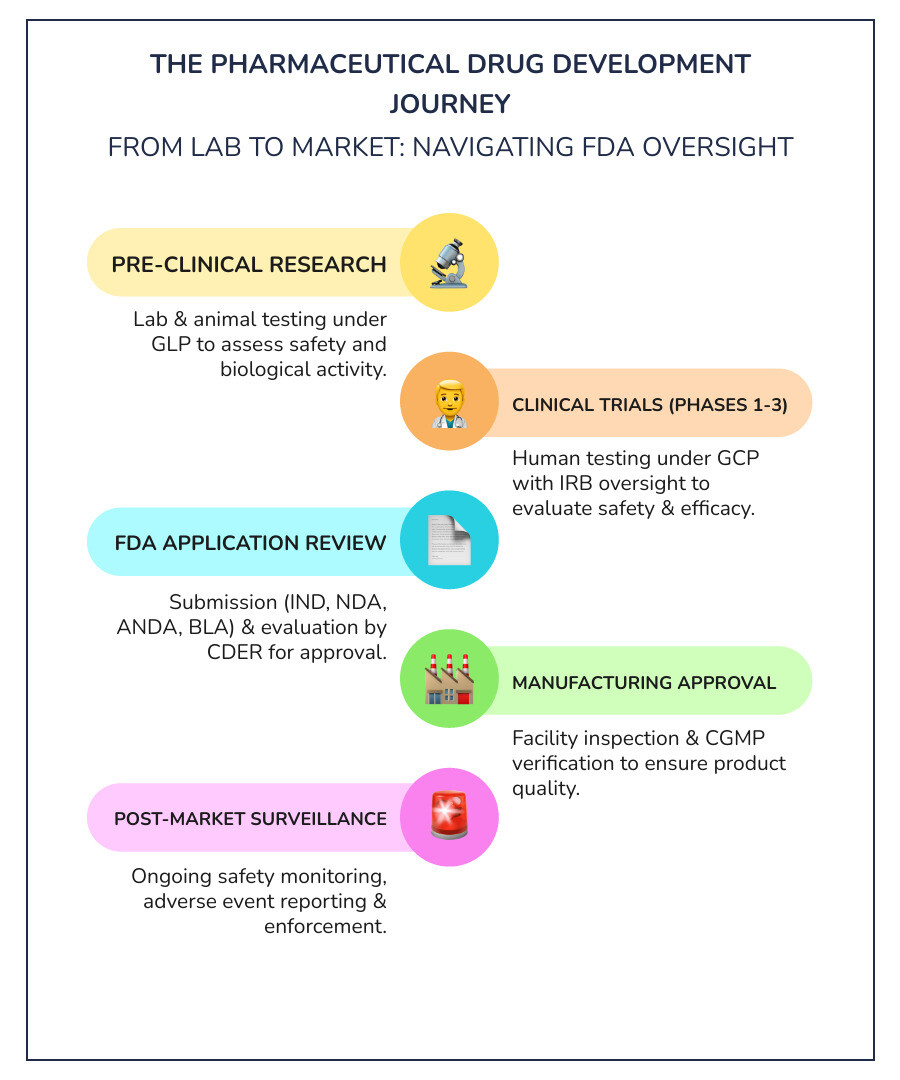
The regulatory journey is long and detailed. It starts with pre-clinical research, moves through multiple phases of clinical trials with strict oversight, continues through rigorous application review processes, and extends well beyond approval into post-market surveillance and compliance.
This guide breaks down the essential FDA regulations every pharmaceutical manufacturer needs to know—from the foundational laws and regulatory framework to specific manufacturing requirements, approval pathways, and enforcement mechanisms.
The Regulatory Foundation: Understanding the FDA’s Framework
At the heart of the FDA’s pharmaceutical regulatory process lies the Center for Drug Evaluation and Research (CDER). This powerhouse division is responsible for ensuring that all drugs marketed in the United States are safe and effective. CDER doesn’t conduct the drug testing itself, but it carefully reviews the data submitted by manufacturers. Its team of physicians, statisticians, chemists, pharmacologists, and other scientists provides an independent and unbiased evaluation of a drug’s safety, efficacy, and quality before it ever reaches patients. CDER also plays a crucial role in providing doctors and patients with the necessary information to use medicines wisely.
The entire regulatory edifice is built upon a bedrock of key laws and acts. The most foundational of these is the Federal Food, Drug, and Cosmetic Act (FFDCA), passed in 1938. This landmark legislation was a direct response to a tragic incident in the late 1930s, where a pharmaceutical product containing a toxic chemical caused over one hundred deaths. The FFDCA famously mandated pre-market FDA approval for all drugs, a critical step that shifted the burden of proof for safety onto manufacturers.
Another pivotal moment in the FDA’s evolution came with the Kefauver-Harris Amendment of 1962. This amendment was spurred by the devastating thalidomide tragedy, where a drug, distributed in the U.S. during its approval process, caused severe birth deformities. The amendment significantly strengthened FDA control over clinical trials, requiring not only that drugs be proven safe but also effective. It also introduced the crucial requirement that volunteer subjects in clinical trials be fully informed of potential hazards and provide signed acknowledgements of their understanding before participating. These historical events underscore how public health crises have repeatedly shaped and strengthened the FDA’s regulatory framework, ensuring continuous evolution towards greater patient safety.
The Hierarchy of Rules: Laws, Regulations, and Guidances
Navigating FDA regulations pharmaceutical requires understanding the distinct hierarchy of regulatory documents: laws, regulations, and guidances.
At the top are laws, enacted by the U.S. Congress, such as the FFDCA. These are broad mandates that set the legal framework.
Next come regulations, which the FDA develops to implement these laws. These are legally binding rules that carry the force of law and specify how the broad legal mandates are to be achieved. They are published in the Federal Register as proposed and final rules, allowing for public comment periods, and are then codified in the Code of Federal Regulations (CFR).
The FDA’s portion of the CFR is found in Title 21, which interprets the FFDCA and related statutes. This comprehensive volume outlines the specific requirements for everything from drug development and manufacturing to labeling and post-market surveillance. It’s our essential roadmap for compliance. You can learn more about Understanding Title 21 of the CFR directly from the source. While the electronic CFR (eCFR) provides a continuously updated online version, the official legal edition is published annually on govinfo.gov.
Below regulations are guidance documents. These represent the FDA’s current thinking on a particular subject. Unlike regulations, guidances are not legally binding. They offer recommendations and best practices, providing clarity on how to comply with regulations. A key insight is that alternative approaches can be used if they satisfy applicable statutes and regulations. We can find information on the FDA’s Good Guidance Practices (GGPs), which dictate how these documents are developed and issued.
Finally, Manuals of Policies and Procedures (MaPPs) provide official instructions for internal practices and procedures followed by CDER staff. These are internal FDA documents that help standardize the drug review process and ensure consistency in the agency’s operations. While not directly binding on industry, they offer a glimpse into the FDA’s internal workings.
Understanding Key FDA Regulations for Pharmaceutical Development
For any pharmaceutical manufacturer, understanding the core components of Title 21 of the CFR is non-negotiable. These parts delineate the responsibilities and requirements throughout a drug’s lifecycle.
- 21 CFR Part 210 and Part 211: Current Good Manufacturing Practice (CGMP). These regulations are the bedrock of pharmaceutical quality. Part 210 provides general CGMP requirements for manufacturing, processing, packing, or holding drugs, while Part 211 details specific CGMP for finished pharmaceuticals. They ensure that drug products meet identity, strength, quality, and purity characteristics. We’ll dig deeper into CGMP later, but suffice it to say, these are critical for our operations.
- 21 CFR Part 312: Investigational New Drug Application (IND). This part outlines the requirements for submitting an IND application, which is necessary before a new drug can be tested in humans. It covers the information required on the drug’s composition, manufacturing, and results from pre-clinical (animal) studies, as well as the proposed clinical investigation plan.
- 21 CFR Part 314: Applications for FDA Approval to Market a New Drug (NDA). This section details the comprehensive application process for bringing a new drug to market after successful clinical trials. It requires extensive data on safety, efficacy, manufacturing, and labeling.
- 21 CFR Part 50: Protection of Human Subjects (Informed Consent). This crucial part sets forth the requirements for informed consent in clinical investigations involving human subjects. It ensures that participants understand the nature, risks, and potential benefits of a study before agreeing to participate. This is a cornerstone of ethical clinical research.
For a comprehensive overview of the regulations governing clinical trials, we can refer to the FDA Regulations for Clinical Trials page, which lists various CFR parts related to human subject protection and study conduct.
The Path to Market: Drug Development and Approval Pathways
The journey of a drug from concept to patient is a long and arduous one, marked by rigorous scientific investigation and regulatory checkpoints. It all begins with pre-clinical research, typically involving laboratory and animal tests. This stage aims to understand how a drug works, its potential toxicity, and whether it’s likely to be safe and effective in humans. These studies are conducted under strict Good Laboratory Practice (GLP) regulations (21 CFR Part 58), which ensure the quality and integrity of nonclinical laboratory studies. This initial phase is crucial for determining if a drug candidate is promising enough to proceed to human testing. We also leverage our expertise in Lab Testing to ensure the quality and consistency of pharmaceutical ingredients and finished products.
If pre-clinical results are favorable, the drug progresses to clinical trials, which involve testing in human subjects. This is where Good Clinical Practice (GCP) comes into play: a set of international ethical and scientific quality standards for designing, conducting, recording, and reporting trials involving human subjects. GCP ensures the protection of human rights, safety, and well-being, as well as the credibility of trial data. Central to GCP are regulations concerning human subject protection and informed consent (21 CFR Part 50). This means potential participants must be fully informed about the study’s purpose, procedures, risks, and benefits before voluntarily agreeing to take part. Oversight for these trials is provided by Institutional Review Boards (IRBs) (21 CFR Part 56), independent committees that review and approve research protocols involving human subjects.
The clinical trial process typically unfolds in phases:
- Phase 1: Small group of healthy volunteers (20-100) to assess safety, dosage, and side effects.
- Phase 2: Larger group of patients (100-300) with the target condition to evaluate effectiveness and further assess safety.
- Phase 3: Even larger group of patients (300-3,000+) to confirm effectiveness, monitor side effects, compare to common treatments, and collect information for safe use.
- Phase 4: Post-marketing studies conducted after a drug is approved and marketed, to gather additional information on the drug’s risks, benefits, and optimal use.
Key Application Types for Drug Approval
Once clinical trials demonstrate a drug’s safety and efficacy, manufacturers submit formal applications to the FDA. Here’s a quick comparison of the main types:
| Application Type | Purpose | Key Content | When to Use |
|---|---|---|---|
| Investigational New Drug (IND) | To gain FDA permission to start clinical trials in humans. | Pre-clinical data, manufacturing information, and clinical trial protocols. | Before testing a new drug in human subjects. |
| New Drug Application (NDA) | To request approval to market a new drug in the U.S. | Full data from pre-clinical and clinical trials proving safety and efficacy, plus manufacturing details and proposed labeling. | After successful completion of clinical trials for a new small-molecule drug. |
| Abbreviated New Drug Application (ANDA) | To get approval for a generic version of a brand-name drug. | Data demonstrating the generic drug is bioequivalent to the brand-name version. | To market a generic drug after the brand-name drug’s patents and exclusivity expire. |
| Biologics License Application (BLA) | To request approval to market a biologic product (e.g., vaccines, antibodies). | Data demonstrating the biologic’s purity, potency, safety, and efficacy. | After successful development and trials for a new biological product. |