

Why Custom Process Equipment is a Strategic Investment
Custom process equipment is industrial machinery designed and fabricated to meet unique operational requirements. When standard, off-the-shelf equipment can’t handle your specialized materials, tight space constraints, or strict regulatory needs, a custom solution becomes essential.
Quick Answer: What You Need to Know
- Definition: Process equipment engineered and built to your exact specifications, from mixing vessels to complete modular process skids.
- Primary Benefit: A perfect fit for your process, facility, and production goals, with no compromises.
- Best For: Complex processes, specialized materials, high-purity requirements, tight spaces, or operations requiring precise control.
- Key Industries: Pharmaceutical, food & beverage, chemical processing, and environmental applications.
- Investment Consideration: Higher upfront engineering costs that typically deliver better long-term ROI through optimized efficiency and reduced operational issues.
Many operations begin with standard equipment, but as processes mature or requirements become more demanding, these solutions often create bottlenecks. You might face challenges with product viscosity, material compatibility, or facility footprints that standard dimensions don’t accommodate. These issues directly impact efficiency, product quality, and your bottom line. The consensus among manufacturers is clear: the right tool for the job delivers better results than forcing an almost-right tool to work.
Custom equipment isn’t about reinventing the wheel; it’s about applying engineering expertise to solve your specific problem efficiently. The process starts with a deep understanding of your requirements: what you’re processing, your quality and throughput goals, and your facility constraints. From there, engineers develop solutions that integrate seamlessly with your existing operations, using your preferred automation platforms and matching your plant standards. The result is equipment that performs exactly as needed, without forcing you to adapt your process to its limitations.
The Strategic Advantage: Custom vs. Standard Equipment
When investing in new process equipment, you face a choice: a standard, off-the-shelf solution or custom process equipment designed for your operation. While standard equipment offers quick availability and a lower initial price, this convenience often comes at the cost of compromises. You may have to accept lower throughput, work around design limitations, or adapt your process to fit the equipment’s constraints.
Custom equipment flips this equation. Instead of forcing your process to adapt, the equipment is engineered to fit your process perfectly, delivering a level of synergy and performance that standard solutions can’t match.
| Feature | Standard (Off-the-Shelf) Equipment | Custom Process Equipment |
|---|---|---|
| Initial Cost | Lower upfront investment | Higher initial engineering and fabrication costs |
| Lead Time | Quick delivery (weeks) | Longer timeline for design, fabrication, and testing (months) |
| Performance | Adequate for general applications; may require process compromises | Optimized for your exact specifications and process parameters |
| Flexibility | Limited adaptability; you work around its constraints | Engineered to integrate seamlessly with your facility and workflow |
| Scalability | Difficult to modify or expand | Designed with future growth and modifications in mind |
| Long-Term Value | May require workarounds, retrofits, or replacement | Higher ROI through optimized efficiency, reduced waste, and fewer operational issues |
With standard equipment, you risk quality assurance challenges if the unit can’t meet product specifications and incompatibility if it doesn’t integrate with existing systems. In contrast, custom equipment offers repeatability of design once proven; a system can be replicated or scaled with confidence. It can also be designed from the start to accommodate evolving production requirements.
Standard equipment works for straightforward needs. But for unique products, specialized materials, or demanding regulations, custom process equipment is essential.
The Core Benefits of Custom Process Equipment
Investing in custom process equipment open ups operational advantages that can transform your production process. Key benefits include:
- Optimized Performance and Efficiency: Equipment is engineered around your specific process parameters, flow rates, temperature profiles, and mixing intensity to maximize throughput and minimize energy costs.
- Perfect Process Integration: Your new equipment fits your plant layout, connects to existing utilities, and integrates with your current automation and control platforms (e.g., Rockwell, Siemens) without expensive modifications.
- Unique Features for a Competitive Advantage: Get specialized systems, such as unique agitation for high-viscosity products or proprietary separation techniques, that aren’t available in a catalog and can set your product apart.
- Reduced Operational Bottlenecks: Custom equipment eliminates weak links in your process line, such as an undersized mixer or an inefficient heat exchanger, allowing your entire operation to run at its full potential.
- Strong Long-Term ROI: While initial costs are higher, the returns from improved efficiency, reduced waste, lower maintenance, and increased throughput often deliver a substantial ROI that far exceeds the upfront investment.
More info about our custom products
Potential Challenges and How to Mitigate Them
While beneficial, custom projects have potential challenges. Understanding and planning for them is key to success.
- Higher Initial Costs: Customization requires significant upfront engineering investment. Mitigation: Focus on the total cost of ownership. A thorough cost-benefit analysis will often show that long-term gains in efficiency and quality justify the initial expense.
- Longer Lead Times: Design, procurement, fabrication, and testing take months, not weeks. Mitigation: Plan ahead. Engage with an experienced manufacturer early in your project’s conceptual phase to establish a realistic timeline.
- Complex Planning: Vague requirements lead to costly redesigns and delays. Mitigation: Invest in thorough Front-End Loading (FEL) or pre-project planning. This collaborative phase aligns all stakeholders on goals, constraints, and success criteria before fabrication begins.
- Choosing the Right Partner: An inexperienced manufacturer can amplify every challenge. Mitigation: Select a partner with a proven track record, extensive engineering capabilities, and in-house fabrication. Our experience across multiple industries means we can anticipate and solve issues effectively.
- Integration Complexity: Connecting new equipment to existing plant controls can be tricky. Mitigation: Work with a manufacturer who understands control systems architecture. We design automation and control cabinets that match your plant standards, ensuring smooth integration with your existing PLC and HMI platforms.
Industries & Applications: Where Custom Equipment Delivers Results
In some industries, standard equipment isn’t an option. When dealing with highly regulated products, aggressive chemicals, or unique processing needs, custom process equipment is essential. Whether scaling up a pilot plant or replacing aging equipment, a custom solution ensures you meet operational and regulatory goals without compromise.
We engineer turnkey process skids, complete, pre-assembled systems that arrive ready for integration. These modular systems reduce installation time while delivering the precision you need. Common custom equipment includes specialized vessels, custom heat transfer systems, unique separation and filtration units, and integrated automation skids with PLC/HMI controls. Each system is built around your process, not the other way around.
Pharmaceutical & Nutraceutical Industries
In pharmaceutical and nutraceutical manufacturing, precision, purity, and compliance with Good Manufacturing Practices (GMP) are non-negotiable. Custom process equipment is designed to meet these stringent hygienic requirements. Every surface is smooth and cleanable, every weld is documented, and every material is traceable. Our stainless steel fabrication, often performed in isolated shops, eliminates crevices where contaminants could hide.
We provide the meticulous documentation needed to support your validation efforts. When a multinational pharmaceutical company needed to expand, it turned to custom hygienic process systems designed for its GMP environment. Our sanitary process systems ensure that every batch meets quality standards and remains fully regulatory compliant.
Explore solutions for the Pharmaceutical Industry
See our Nutraceutical Industry applications
Food & Beverage Processing
The food and beverage industry requires equipment that is both sanitary and flexible. Sanitary blending systems are where custom design excels, ensuring the perfect consistency for products from thick sauces to delicate beverages. The ability to achieve specific textures and scale production efficiently is key to market success.
Modular process equipment offers invaluable adaptability. When consumer tastes shift, you need to respond quickly. For example, a food-ingredient manufacturer met growing market demand by using custom modular skids, allowing them to scale production without disrupting existing operations. Our solutions focus on product quality, safety, and efficiency.
Learn about our Food & Beverage Industry expertise
Chemical and Environmental Sectors
Handling aggressive chemicals, high pressures, or complex waste streams requires equipment built for the job. In these sectors, specialized alloys like Hastelloy and Inconel are critical for corrosion resistance, safety, and longevity. We select materials based on your specific process chemistry to ensure long-term reliability.
Custom process equipment is particularly valuable for pilot plants and process skids. As industry experts note, custom designs offer superior compatibility with existing plants. This is crucial for applications such as solvent recovery systems, where efficiency affects both your bottom line and your environmental footprint. To reduce waste streams, our thermal drying and solidification systems are engineered to handle the toughest challenges while maintaining environmental compliance.
View our Chemical Industry solutions
Discover our Environmental Industry applications
The Custom Equipment Journey: From Concept to Commissioning
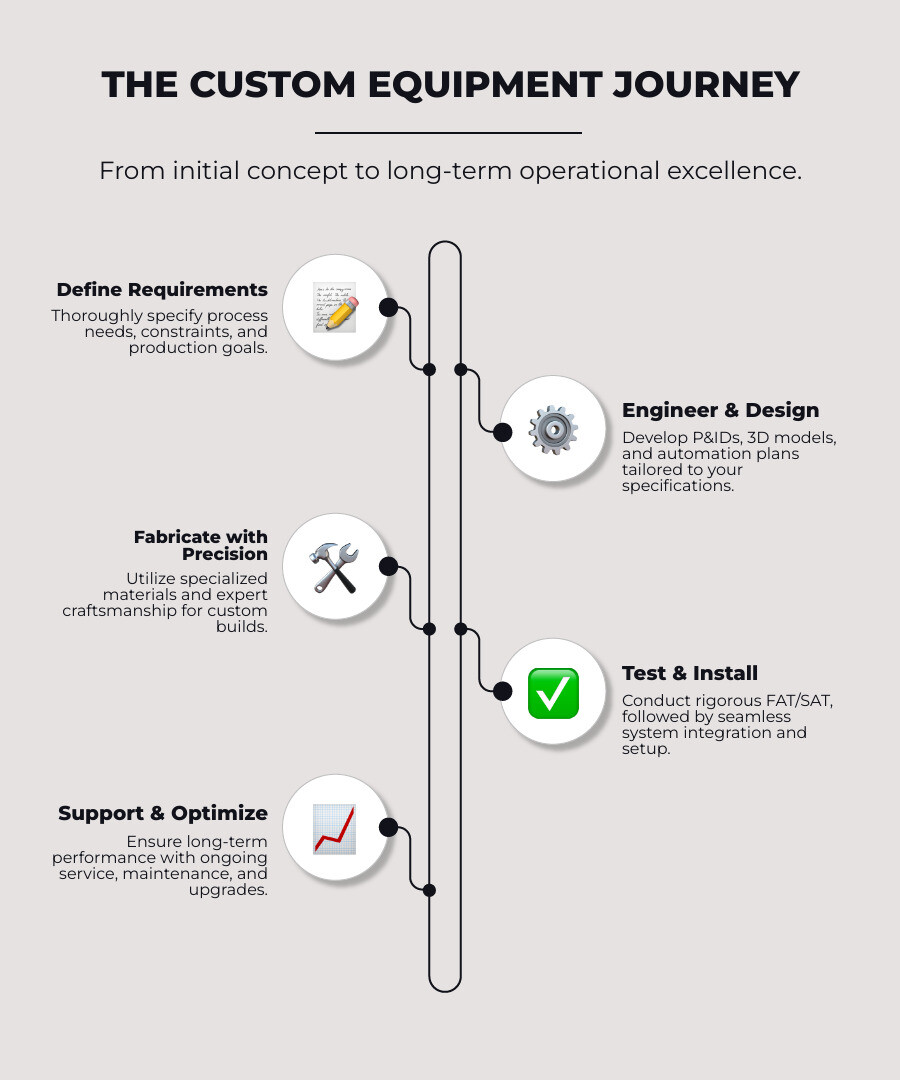
Building custom process equipment is a collaborative journey that transforms your specific needs into a fully operational system. You bring the process knowledge; we bring nearly a century of engineering and fabrication expertise. Together, we steer the project lifecycle, mitigating risks early to ensure a smooth project that delivers equipment that performs as promised. The journey unfolds across three key stages.
Stage 1: Design, Engineering, and Automation
Every successful project begins with a deep understanding of your goals. During project definition, we work with your team to gather and refine all requirements product specifications, throughput needs, space constraints, and regulatory standards. Once specifications are locked, our engineers begin the design phase.
This is where your requirements become technical plans. We develop Process Flow Diagrams (PFDs) and Piping and Instrumentation Diagrams (P&IDs) that map out every component and control loop for your review. Using advanced software, we create detailed 3D models of the equipment, allowing you to virtually walk through the layout and spot potential issues before fabrication. For novel concepts, a Proof of Concept (POC) may be used to validate designs.
Modern equipment is smart, so we design automation and control systems in parallel. We create systems with PLC/HMI integration that feel like a natural extension of your plant, using components that match your standards and are familiar to your team. If you’re unsure how a process will perform at scale, our lab testing facilities can help you optimize before committing to full-scale production.
Stage 2: Fabrication and Materials Selection
With the design approved, our skilled craftsmen begin fabrication. Materials selection is critical and is based on your specific process conditions. Stainless steel is the standard for hygienic applications due to its corrosion resistance and cleanability. For more demanding processes with aggressive chemicals or extreme temperatures, we use specialized alloys like Hastelloy, Inconel, or Monel to ensure longevity.
Our fabrication process adheres to strict standards, including ASME Section VIII for pressure vessels. We follow precise, documented methods for every weld and finish, which is vital for GMP environments. Many solutions are built as modular, skid-mounted systems. Fabricating skids in our controlled facility reduces on-site construction time, streamlines installation, and allows for more rigorous quality control, ensuring you receive equipment built to the highest standards.
See our Evaporation, Distillation & Separation equipment
Stage 3: Testing, Installation, and Startup
This final stage ensures your equipment works perfectly in your facility. It begins with Factory Acceptance Testing (FAT) at our facility once assembly is complete. We invite your team to participate as we run functional tests, verify performance against specifications, and check all safety interlocks. This step significantly reduces the risk of on-site surprises.
After a successful FAT, the equipment is shipped to your facility. Our technicians can provide installation support to ensure seamless integration with your existing systems. Once installed, we conduct Site Acceptance Testing (SAT), which verifies that the equipment functions correctly in your operational environment using your actual product or simulants. SAT is the final confirmation that the equipment is ready for production.
We don’t just flip a switch and leave. Our field service team provides comprehensive operator training on operation, troubleshooting, and maintenance. Following a successful SAT, the equipment is officially commissioned, and our team provides startup support to ensure a smooth transition into full operation.
We offer comprehensive Field Service
Key Factors in Planning Your Custom Process Equipment Project
Thoughtful planning is the foundation of a successful custom process equipment project. As with building a house, you need blueprints, a budget, and a reliable contractor to avoid costly surprises. Strategic planning involves thinking beyond the immediate installation to consider long-term production goals, potential product line evolution, and future regulatory changes. This foresight shapes everything from design to material selection, ensuring you end up with equipment that serves your business for years to come.
Key planning considerations include:
- Budgeting: While upfront engineering costs are higher than for off-the-shelf solutions, the investment pays off through greater operational efficiency, reduced waste, and long-term reliability.
- Lead Time: Custom projects take months. Building this timeline into your project schedule from the start makes it a manageable milestone rather than a delay.
- Regulatory Compliance: Build requirements like GMP or sanitary design principles into the initial design. It’s far easier and cheaper than retrofitting later.
- Future-Proofing: Design with adaptability in mind. Consider if the system needs to scale, handle new formulations, or integrate with future technologies.
Selecting the Right Custom Process Equipment Manufacturer
Your manufacturing partner can make or break your project. You are entering a long-term relationship, not just making a purchase. Look for a partner with:
- Experience and Expertise: A manufacturer that has solved similar challenges in your industry offers invaluable insights. Our century of experience across food, chemical, and pharmaceutical sectors means we’ve likely solved a problem like yours before.
- Strong Engineering Capabilities: Your partner should have a creative, proficient team fluent in tools such as 3D modeling and P&ID development, backed by practical, hands-on expertise.
- In-House Fabrication: This gives a manufacturer better control over quality and timelines, enabling seamless communication between engineers and craftsmen and allowing issues to be solved quickly.
- Quality Management Systems: Certifications such as ASME and a commitment to GMP compliance provide assurance that every component meets rigorous standards.
- Customer-Centric Support: A true partner communicates clearly, responds promptly, and is invested in your success long after the sale.
The Role of Modular Design and Flexibility
Modular design has transformed custom process equipment by offering remarkable flexibility. Because modules are fabricated off-site as pre-piped and pre-wired units, they offer several advantages:
- Scalability: Add another module to increase capacity rather than replacing the entire system.
- Ease of Installation: Drastically reduces on-site construction time and disruption to your operations.
- Flexibility: Modular equipment can be more easily disassembled, moved, and reassembled if you relocate or reorganize your facility.
- Future Adaptability: Individual modules can be upgraded or replaced as technology or product needs evolve, extending the life of your investment.
Explore our Thermal Drying & Solidification solutions
Long-Term Support and Upgradability
The project doesn’t end at startup. Long-term support is crucial for maintaining peak performance for years to come.
Aftermarket services, including maintenance and repair, are your safety net for maximizing uptime. Using original equipment manufacturer parts ensures a precision fit and proven compatibility for reliable, lasting fixes. We provide both spare parts and expert field service technicians who know your system intimately.
System upgrades are a smart way to protect your initial investment. Targeted upgrades can add new capabilities, improve automation, or increase capacity, allowing your equipment to adapt to evolving business needs. This is far more cost-effective than complete replacement and reduces operational disruption.
Find Spare Parts for your equipment Learn about our Aftermarket support
Conclusion: Engineer Your Success with a Trusted Partner
Choosing custom process equipment is a strategic decision that shapes your operation’s future. While standard equipment can lead to compromises, a custom solution is engineered specifically for your unique challenges, facility constraints, and production goals. The result is higher efficiency, fewer bottlenecks, and better product quality.
The initial investment in engineering is higher, but the long-term ROI from years of optimized performance, reduced waste, and lower maintenance costs is clear. This is true whether you’re in the pharmaceutical, food, chemical, or environmental industry, where generic equipment simply can’t meet specific demands.
The journey from concept to commissioning requires a true partnership. At Buflovak, we’ve spent nearly a century engineering custom solutions for thermal drying, evaporation, distillation, and separation. We work with you to understand your goals and design systems that integrate seamlessly into your operation. Our commitment extends well beyond startup, with aftermarket support to keep your equipment running at peak performance throughout its entire lifespan.
If you’re ready to move beyond the limitations of standard equipment, we’re ready to help. Let’s engineer your success together.
Explore our custom distillation systems and heat transfer equipment to start your project