

Last updated on January 8th, 2026 at 03:27 pm
Understanding Industrial Drum Dryers: The Workhorses of Industrial Drying
An industrial drum dryer is a rotating cylindrical vessel that removes moisture from materials using heated gas or indirect heat. These robust systems can handle a wide range of materials, including sand, fertilizers, food products, and pharmaceutical ingredients.
Key characteristics of industrial drum dryers:
- Capacity range: 1-200+ tons per hour with drum diameters from 3-15 feet
- Heating methods: Direct (hot gas contact) or indirect (steam, thermal oil, hot water)
- Operation types: Atmospheric or vacuum for heat-sensitive materials
- Applications: Mining, food processing, chemicals, pharmaceuticals, waste management
Industrial drum dryers are known as the “workhorse of industrial dryers” for their efficiency in processing a wide variety of materials across countless industries. Whether you’re dealing with aggregates, biosolids, or delicate food products, a drum dryer can be configured to fit your needs.
Inside, specially designed lifting flights tumble materials through a hot gas stream or across a heated drum surface. This continuous motion maximizes heat transfer and prevents sticking or burning.
Direct vs. indirect heating is a key factor in dryer selection:
- Direct dryers are highly efficient for robust materials like wood chips and aggregates.
- Indirect dryers protect sensitive materials from contamination and overheating.
For heat-sensitive products, vacuum drum dryers reduce atmospheric pressure, allowing water to evaporate at much lower temperatures, preserving product quality.
How Industrial Drum Dryers Work: Core Principles and Components
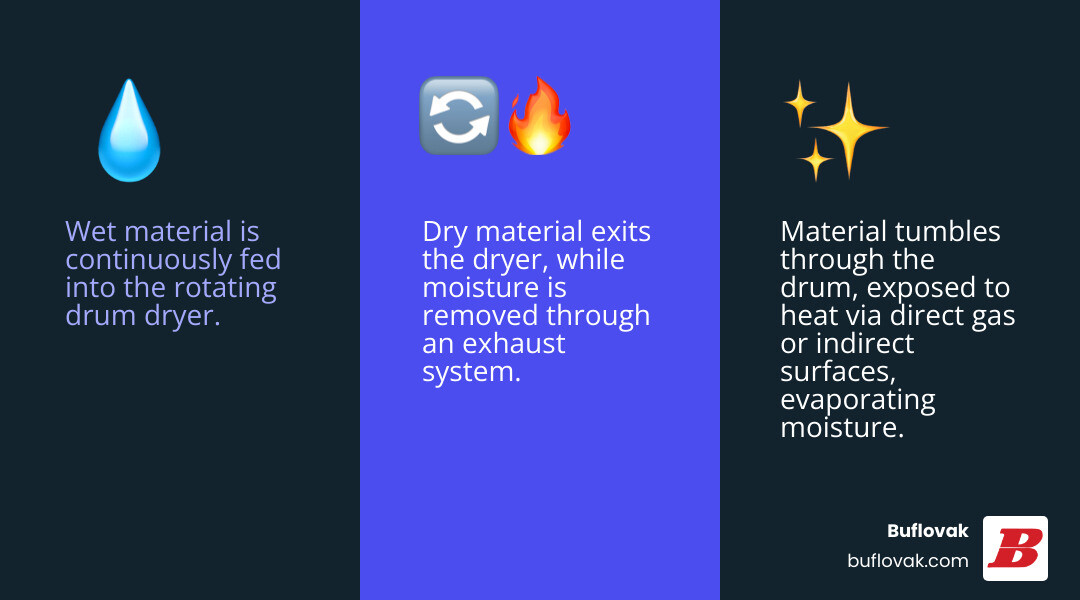
An industrial drum dryer operates on a simple principle: continuous contact between wet material and heat inside a slowly rotating cylinder. Wet material enters one end of the slightly tilted drum. Internal lifting flights carry the material up and then let it cascade down through the heated environment. This tumbling action exposes the maximum surface area to heat, ensuring even and efficient moisture removal without clumping or hot spots. For a general overview of rotary dryers, see Rotary dryer.
Heat transfer occurs via conduction and convection. In direct heating, hot gases flow through the drum, directly contacting the material. With indirect heating, the drum walls or internal tubes are heated (by steam or thermal oil), and materials dry by touching these hot surfaces.
The combination of the rotating cylinder, lifting flights, and material tumbling creates a continuous cycle of lift, fall, and heat exposure that makes industrial drying so effective.
Essential Dryer Components
An industrial drum dryer consists of several critical components:
- The feed hopper ensures a steady, controlled flow of wet material into the drum.
- The rotating drum shell, typically 3 to 15 feet in diameter and made of heavy-duty steel or alloys, is slightly tilted to facilitate material movement.
- The heat source provides drying energy, using burners (natural gas, propane, oil) or steam systems for indirect heating.
- The exhaust system manages moisture-laden air using fans, cyclones, and often baghouses or scrubbers to control emissions.
- The discharge chute is where dried materials exit the system.
- A robust support structure with trunnion rollers bears the weight of the rotating drum.
- The drive mechanism (motor and gearbox) rotates the drum at a precise speed for optimal drying.
Direct vs. Indirect Heating: What’s the Difference?
The choice between direct and indirect heating is critical, as it affects both efficiency and product quality.
Direct heating brings hot combustion gases into direct contact with the material. It is highly efficient and ideal for robust materials like aggregates, sand, and wood chips that are not sensitive to combustion byproducts.
Indirect heating is a gentler approach where heat is transferred through the drum walls or internal steam tubes. This method, often using an external furnace or steam, protects sensitive products from contamination and allows for precise temperature control.
| Feature | Direct Heated Dryers | Indirect Heated Dryers |
|---|---|---|
| Heat Source Contact | Hot combustion gases directly contact material | Heat transferred through drum walls or internal tubes (steam, thermal oil) |
| Thermal Efficiency | Very high; minimal heat loss | High, but slightly less than direct due to transfer medium |
| Contamination Risk | Higher risk from combustion byproducts | Very low; product isolated from combustion gases |
| Best-Suited Materials | Aggregates, sand, minerals, wood chips | Food products, pharmaceuticals, heat-sensitive materials |
Atmospheric and Vacuum Drum Dryers

Most industrial drum dryers are atmospheric single drum dryers that operate at normal pressure, handling a majority of applications cost-effectively.
However, vacuum drying is a game-changer for heat-sensitive materials like delicate food ingredients or pharmaceuticals. By reducing pressure inside the drum, water boils at much lower temperatures (e.g., 40°C instead of 100°C). This gentle process preserves flavors, colors, and chemical integrity that high temperatures would destroy. Vacuum double drum dryers are engineered for these premium applications, ensuring valuable products maintain their quality.
Applications Across Industries: What Materials Can Drum Dryers Process?
The versatility of an industrial drum dryer is remarkable, handling an incredible range of materials across virtually every industry. From tough mining materials that withstand high heat to delicate pharmaceutical ingredients needing gentle handling, a drum dryer can be configured to fit the application.
- Food & Beverage: Essential for preserving products like baby food, dairy, grains, and coffee beans, maintaining quality and extending shelf life.
- Chemical: Used for processing inorganic and organic chemicals, powders, and granules where precise moisture control is critical for stability and safety.
- Pharmaceutical: Specialized dryers handle active pharmaceutical ingredients (APIs) and excipients, often requiring hygienic designs and gentle temperatures to preserve efficacy.
- Mining & Minerals: Workhorses for drying ores, concentrates, sand, stone, and coal, preparing them for transport or further processing.
- Agriculture: Process by-products, animal feeds, manure, and fertilizers to improve storage, reduce transport weight, and increase value.
- Environmental & Waste Management: Process biosolids, reclaimed dust, and industrial sludges, turning waste into useful resources and reducing environmental impact.
Common Materials Processed
The list of materials an industrial drum dryer can handle is extensive. We have experience processing everything from aggregates (sand, gravel) and fertilizers to biosolids and manure, turning waste streams into valuable resources. Other common materials include:
- Animal feeds
- Ores and concentrates (iron ore, bauxite, potash)
- Limestone and gypsum
- Salts and sugars
- Wood chips and biomass
- Plastic pellets and grains
- Paper sludge
- Metal chips and shavings
- Fly ash
This wide range of applications highlights why industrial drum dryer technology is a cornerstone of modern processing. Each material presents unique challenges, from heat sensitivity to abrasiveness, requiring expert design and customization.
For more details about our comprehensive drying solutions for these and many other materials, explore our full range of drying solutions.
Key Design Factors and Efficiency for Your Industrial Drum Dryer
Choosing the right industrial drum dryer requires custom engineering based on your material and production goals. A standard system might work, but a thoughtfully designed dryer saves money, improves product quality, and runs more reliably. Our century of experience ensures we deliver a custom-engineered system that optimizes your entire process.

Factors Affecting Dryer Efficiency
Several key factors determine dryer performance:
- Fuel type: Natural gas, oil, coal, or biomass affects operating costs and environmental footprint.
- Gas flow configuration: In co-current flow, material and hot gas travel in the same direction, ideal for heat-sensitive materials. Counter-current flow, where they move in opposite directions, is more energy-efficient and achieves lower final moisture content but is not suited for delicate products.
- Drum design: Single-shell designs are simple, while multi-shell (double or triple) designs pack more drying power into a smaller footprint, increasing residence time and thermal efficiency.
- Residence time: The time material spends in the dryer is controlled by drum inclination, rotation speed, and flight design to achieve the target moisture content.
- Temperature control: Precise temperature management ensures the product gets the heat it needs without damage.
Custom Features for an industrial drum dryer
We offer custom features to meet specific industry demands:
- Advanced automation: Control systems provide precise process control, consistent product quality, and data logging for optimization.
- Hygienic design: For food and pharmaceutical use, we design systems to HACCP and EHEDG standards with easy-to-clean surfaces to prevent contamination.
- Wear-resistant coatings: High-velocity thermal spray coatings protect equipment from abrasive materials, extending its life.
- Integrated cooling systems: We can add cooling sections or pair dryers with equipment like cooling drum flakers to deliver product at the correct temperature for packaging.
- Material of construction: We select from various grades of stainless steel for corrosion resistance and hygiene or carbon steel for other industrial materials.
Selecting the right industrial drum dryer
Proper dryer selection is critical for long-term success. Key considerations include:
- Material characteristics: Particle size, initial and target moisture content, and thermal sensitivity dictate the dryer’s design. Properties like abrasiveness or stickiness require specific solutions.
- Capacity requirements: We size dryers from 1 TPH to over 200 TPH, considering continuous vs. batch processing and surge capacity needs.
- Production goals: We help balance competing goals like maximum efficiency, product purity, and low energy consumption.
There is no substitute for pilot testing. Our Lab Testing facilities allow us to test your material to determine optimal parameters and fine-tune the design before you invest in a full system. This ensures your dryer performs as promised from day one.
The Future of Industrial Drying: Innovations and Safety
The industrial drum dryer industry is rapidly evolving to meet future challenges like rising energy costs and stricter environmental regulations. Manufacturers are constantly innovating to deliver more efficient, safer, and sustainable solutions.
Our customer-focused approach drives our commitment to advancing the industry. You can read more about these innovations in our blog post: Drum Dryers Help Processors Maximize Efficiency and Product Quality.
Technological Trends and Innovations
Key developments are reshaping industrial drying processes:
- Energy recovery systems: Sophisticated heat exchangers and cogeneration systems capture waste heat to reduce energy costs. Our heat of compression technology is a game-changer, enabling a dryer’s motor and controls to run on less than 120 watts of power.
- Advanced process controls: Smart systems use real-time sensor data to automatically adjust temperature, airflow, and rotation speed for optimal results and consistency.
- Zero-purge designs: These innovative systems eliminate waste by recycling compressed air during regeneration cycles, saving energy and reducing costs.
- High-velocity thermal spray coatings: Advanced coatings protect equipment from abrasive materials, extending service life and reducing maintenance, even in food-grade applications.
- Improved hygienic standards (EHEDG): For food and pharma, we design 100% closed systems with minimal energy use and near-zero dust emissions, simplifying cleaning and ensuring compliance.
Safety and Environmental Considerations
Safety and environmental protection are integral to our designs.
- Dust emission control: Systems integrate cyclones, baghouses, and scrubbers to manage airborne particles, mitigating health hazards, explosion risks, and ensuring clean exhaust.
- Handling of hazardous materials: For toxic, flammable, or explosive materials, we incorporate specialized features like inert gas purging, explosion panels, and automated safety shutoffs.
- Operator safety protocols: Comprehensive safety interlocks, clear procedures, and automated monitoring are built into our control systems to protect personnel.
- Explosion prevention: We follow strict NFPA standards for combustible dusts, including deflagration venting and suppression systems.
- Environmental regulations: Our systems are designed to meet or exceed current and future standards, including the elimination of harmful refrigerants in our heat-of-compression dryers.
Frequently Asked Questions about Industrial Drum Dryers
Here are answers to common questions about choosing an industrial drum dryer for your operation.
What is the primary advantage of a rotary drum dryer?
The primary advantage is versatility. These robust machines efficiently process large volumes of diverse materials, from fine powders to chunky aggregates, making them a “workhorse of industrial dryers” for continuous operation. Their flexibility, robust construction, and relatively low operating costs make them indispensable across many industries.
Can drum dryers be used for heat-sensitive products like food or pharmaceuticals?
Yes. While direct-heated dryers are for tough materials, specialized configurations are designed for delicate products.
Indirectly heated drum dryers are ideal for heat-sensitive materials. Heat transfers through the drum walls via steam or thermal oil, providing gentle, controlled heating without direct contact from combustion gases.
For extremely delicate materials, vacuum drum dryers are the solution. By reducing pressure, water boils at much lower temperatures (e.g., 40°C). This protects the flavor, color, nutritional value, and chemical integrity of high-value products.
How is drying efficiency measured and improved?
Efficiency is measured by the energy consumed per unit of water evaporated. It can be improved through smart engineering:
- Counter-current gas flow maximizes heat transfer for higher efficiency.
- Multi-shell designs increase drying length in a compact footprint.
- Heat recovery systems capture waste heat from exhaust gases to preheat air, cutting energy bills significantly.
- Proper insulation and precise temperature control prevent energy loss.
A well-designed industrial drum dryer with modern efficiency features reduces operating costs. Since every application is different, we recommend starting with our Lab Testing to optimize the design for your specific material.
Conclusion
The industrial drum dryer is more than just equipment; it’s the backbone of countless industries. These workhorses have earned their reputation for versatility, handling everything from robust materials with atmospheric drying to delicate pharmaceuticals with vacuum drying.
What sets these systems apart is the balance of efficiency with customization. While the principles of tumbling materials and precise heat transfer are consistent, every detail—from heating method to flight design—can be customized to your exact needs. Modern technological innovations like energy recovery and advanced hygienic designs deliver practical value to your bottom line and product quality.
With over a century of experience, Buflovak’s engineers apply generations of wisdom to solve your unique drying challenges. We don’t offer one-size-fits-all solutions; we know your materials and goals are unique.
Our engineering-driven approach means we partner with you to optimize your entire operation, from lab testing to long-term support.
Ready to see what an industrial drum dryer can do for your operation? Let us show you how our century of expertise can make a difference.
Request a Quote today to discuss your drying needs.
For a complete overview of our capabilities, explore our full range of Thermal Drying & Solidification equipment.
