

Last updated on March 27th, 2026 at 02:02 pm
Why Finding the Right Drum Drying Resources Matters
Drum drying resources provide the specialized equipment, expertise, and support needed for efficient industrial moisture removal. For food, pharmaceutical, or chemical products, the right resources ensure optimal performance and reliability.
Quick Overview: Essential Drum Drying Resources
- Equipment Manufacturers – Companies that manufacture, refurbish, and retrofit single and double drum dryers
- Technical Expertise – Engineering consultation, pilot plant testing, and custom system design
- Industry Knowledge – Specialists serving food processing, pharmaceutical, and chemical sectors
- Procurement Services – Access to both new and used equipment through specialized agents
- Aftermarket Support – Reconditioning, spare parts, and ongoing maintenance services
Drum dryers apply a liquid or slurry onto heated rotating cylinders, where moisture evaporates via indirect conductive heat transfer. This process creates dried flakes or powders with precise moisture content, often within ±0.5% of the target.
This century-old technology offers superior thermal efficiency (85-90%), a compact footprint (30-40% less space than spray dryers), and versatility for a wide range of materials.
However, not all drum drying systems are the same. Material characteristics like viscosity and heat sensitivity require careful matching with the right equipment. A standard system without product-specific testing can lead to poor results and wasted investment. Finding quality drum drying resources means connecting with manufacturers who understand your product, offer pilot testing, and provide long-term support.
Understanding Drum Dryer Fundamentals
Drum dryers transform liquid or semi-liquid materials into dried, shelf-stable products. The process is simple: heated rotating cylinders evaporate moisture with remarkable precision, making it one of the most efficient and versatile drying technologies available.
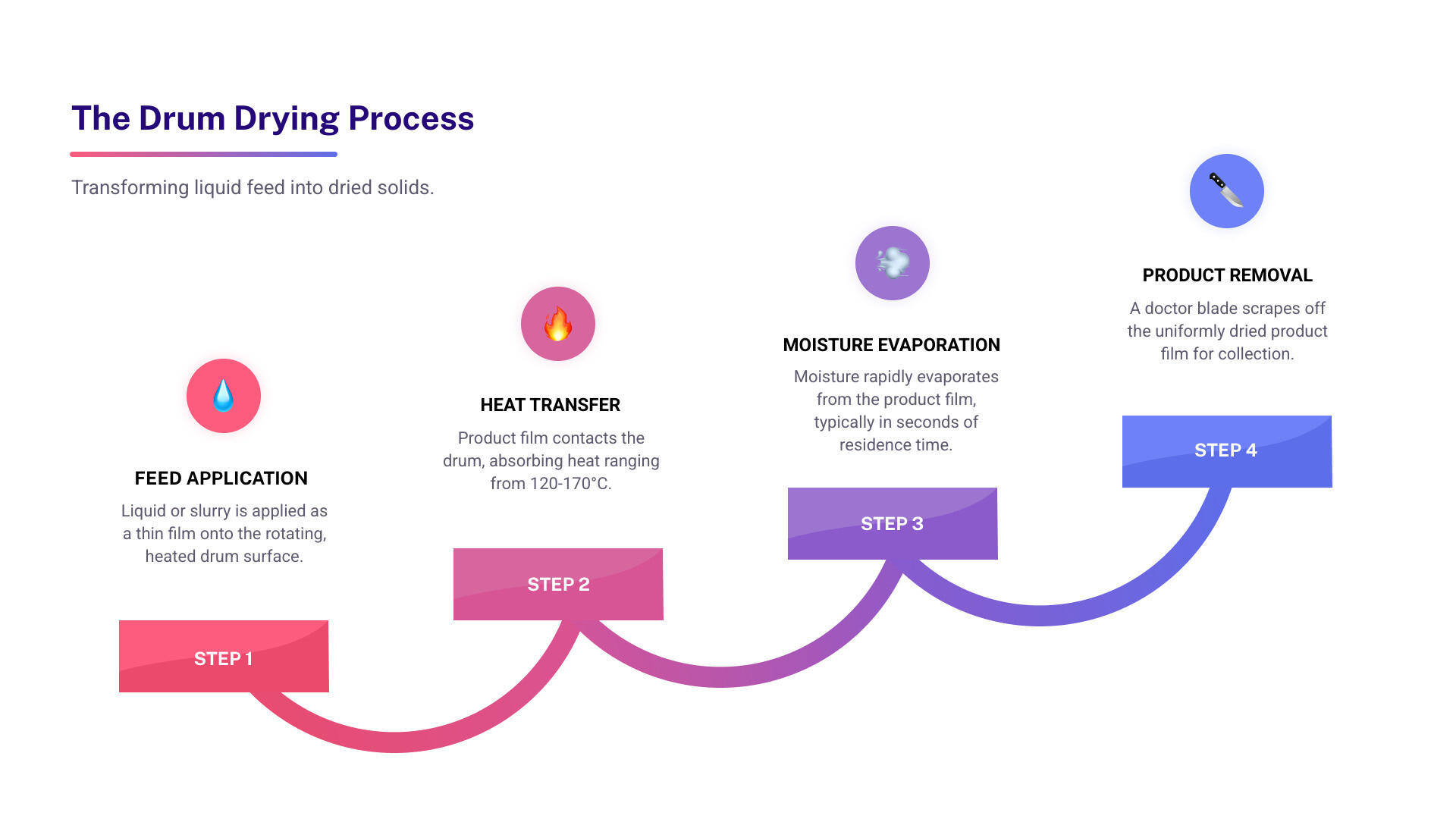
The science is based on conductive heat transfer. When a liquid or slurry touches the heated drum, heat moves directly into the product, causing rapid evaporation. This direct contact delivers high thermal efficiency of 85-90%, ensuring most energy is used for drying.
The material spends only seconds on the drum surface, which typically operates at 120-170°C. This brief heat exposure is crucial for heat-sensitive products, as it minimizes thermal degradation.
After evaporation, the dried material forms a thin film, which a stationary doctor blade scrapes off as flakes or powder. This continuous process ensures consistent quality and precise moisture control, often within ±0.5% of the target.
Drum dryers also offer a compact footprint, requiring 30-40% less floor space than comparable spray dryers. However, the product must be able to form a stable film on the drum (product adhesion requirements), and extremely delicate compounds may have thermal sensitivity limitations.
Key Advantages of Drum Drying Technology
Drum dryers offer a unique combination of efficiency and versatility that translates directly to your bottom line and product quality.
- Superior heat transfer: Direct contact between the product and the heated drum creates conductive heat transfer that is more efficient than convective methods. This results in rapid moisture removal with thermal efficiencies of 85-90%.
- Gentle processing: The short residence time of just a few seconds protects heat-sensitive products, preserving flavors, active compounds, and nutritional value.
- Scalability: Drum dryers can be configured for specialty batches or high-volume production, allowing the technology to adapt as your business grows.
- Energy efficiency: Beyond high thermal performance, modern systems can include energy recovery units that capture up to 40% of waste heat, reducing operational costs.
- Versatility: These machines handle a wide range of materials, from thick pastes to thin liquids. Their compact footprint also saves valuable facility space.
For a deeper look at how these advantages play out in real-world applications, check out how Drum Dryers Help Processors Maximize Efficiency and Product Quality.
Common Challenges and Limitations
Understanding the limitations of drum dryers helps ensure the right fit for your application.
- Product film-forming properties: The material must form a stable, uniform film on the drum. Products that are too sticky or do not adhere well can be challenging, which is why pilot testing is critical.
- Potential for thermal degradation: While the short residence time is gentle, extremely delicate compounds may still be damaged by high temperatures. Vacuum drum dryers offer a solution by operating at lower temperatures.
- Maintenance of doctor blades: These blades are wear components that require regular inspection and maintenance to ensure efficient product removal and protect the drum surface.
- Batch-to-batch consistency: Maintaining absolute consistency over long runs requires careful monitoring and adjustment of operational parameters.
- Capital investment: High-quality drum dryers are a significant investment. However, their energy efficiency, long lifespan, and reliability often result in a lower total cost of ownership compared to alternatives.
Understanding these challenges allows us to design solutions, such as product pre-treatment or vacuum systems, to ensure optimal performance.
Types of Industrial Drum Dryers
Choosing the right drum drying resources starts with understanding which type of drum dryer best fits your product. Industrial drum dryers come in several configurations, and matching the equipment to your application is key to success.
Let’s review the three main types.
| Feature | Single Drum | Double Drum | Vacuum Drum |
|---|---|---|---|
| Application | Pastes, high-viscosity slurries | Liquids, lower-viscosity slurries | Heat-sensitive products |
| Operating Temperature | 120-170°C | 120-170°C | 40-60°C |
| Operating Pressure | Atmospheric | Atmospheric | Vacuum (low pressure) |
| Feed Method | Applicator rolls or spray | Nip feed between drums | Nip feed in vacuum chamber |
| Product Suitability | Materials requiring gentle application | High-volume uniform drying | Products prone to thermal degradation |
| Capacity | Moderate | High | Moderate to high |
Atmosphärische Einzeltrommeltrockner
A single drum dryer features one large, rotating heated drum. The feed is applied using applicator rolls or a spray system, spreading it into a thin film. As the drum rotates, the product dries and is removed by a stationary doctor knife. These systems are highly effective for pastes and high-viscosity slurries that require controlled application. Their robust, simple design ensures reliable, long-term operation.
You can learn more about our specific designs and capabilities for Atmospheric Single Drum Dryers.
Atmosphärische Doppeltrommeltrockner
Double drum dryers use two heated drums rotating toward each other, creating a “nip” where the feed is introduced. The liquid is pulled into the nip, forming a film on both drum surfaces. This design offers increased capacity in a similar footprint, making it ideal for liquids and lower-viscosity slurries that require rapid, uniform drying for high-volume production.
Find the benefits and applications of our Atmospheric Double Drum Dryers.
Vakuumtrommeltrockner
For products that cannot tolerate high temperatures, vacuum drum dryers are essential. These systems operate inside an enclosed chamber under low-pressure operation, which lowers the boiling point of water. This allows for effective drying at temperatures as low as 40-60°C, preserving the nutritional content, bio-activity, or flavor of heat-sensitive materials. They are critical for active pharmaceutical ingredients (APIs), specialty chemicals, and delicate food ingredients. While the initial investment is higher, they are invaluable when product integrity is paramount.
Explore the specialized capabilities of our Vacuum Double Drum Dryers.
Your Guide to Essential Drum Drying Resources
Finding quality drum drying resources is about connecting with partners who understand your entire process, from product testing to long-term support. The right resources begin with expertise, including pilot testing facilities and engineering teams who understand the nuances of heat transfer and product behavior. When sourcing equipment, evaluate suppliers on their engineering capabilities, industry experience, and commitment to aftermarket support.
Key Industries and Applications
Drum drying serves a wide range of industries with unique quality standards.
- Food processing: Produces instant potato flakes, pre-gelatinized starches, fruit purees, dairy powders, and baby food.
- Pharmaceuticals: Dries active pharmaceutical ingredients (APIs), especially heat-sensitive compounds, using vacuum drum dryers to preserve efficacy.
- Chemical manufacturing: Used for polymer processing, specialty adhesives, and other compounds requiring precise moisture control.
- Environmental waste processing: Contributes to sustainability by processing sludge, biosolids, and fermentation by-products. Recent scientific research on fruit by-product drying highlights its role in creating value from waste.
How to Select the Right Drum Drying Resources
Selecting the right dryer involves several key considerations:
- Feed characteristics: The material’s solids content, viscosity, and heat sensitivity determine the best dryer type.
- Required production capacity: Assess current needs and plan for future growth to avoid bottlenecks.
- Final moisture content: The target moisture level influences operating parameters and equipment choice.
- Energy consumption: Modern dryers offer 85-90% thermal efficiency, and heat recovery systems can further reduce costs.
- Total cost of ownership: Look beyond the initial purchase price to include energy, maintenance, and labor costs over the equipment’s 20-30 year lifespan.
Finding Technical and Engineering Drum Drying Resources
The most valuable resources are often the technical expertise and engineering support that ensure optimal performance.
- Pilot plant testing: Testing your product in a pilot facility is crucial to verify its behavior and define process parameters before scaling up.
- Process development: Engineers work with you to refine the entire process, from feed preparation to post-drying handling.
- Custom engineering: A bespoke approach, as detailed in resources like the Handbook of Industrial Drying, ensures the system is designed for your specific product and facility.
- System integration: A holistic view considers the entire production line, including material flow, automation, and controls.
- Quality standards: Adherence to rigorous industry and internal standards ensures reliable equipment and consistent product quality.
Innovations and Custom Solutions in Drum Drying
The drum drying industry continues to evolve with advancements like advanced control systems, hybrid drying technologies, and modular designs. Innovations in energy recovery systems are particularly impactful, with modern dryers capturing up to 40% of waste heat from vapor streams. These customization benefits are about precisely matching the technology to your product and process.
The Value of Custom-Engineered Systems
Standard, off-the-shelf dryers often fail to deliver optimal results. A custom solution is essential because every product is unique. A system that is custom to product requirements is based on pilot testing your specific material to determine its behavior and define the ideal process.
This custom approach leads to:
- Optimized efficiency: The dryer works with your product’s characteristics, not against them.
- Reduced operational costs: Clients often see 15-25% lower costs from reduced energy use, less waste, and fewer shutdowns.
- Higher product quality: Consistent moisture content, color, and flavor are achieved batch after batch.
- Scalability for future growth: Systems are designed to expand with your business.
Services Beyond Manufacturing: Refurbishment and Support
Our commitment is long-term, extending far beyond the initial sale.
- Engineering services: Our experienced team is available to help optimize your process or solve challenges.
- Retrofitting and Reconditioning: We can upgrade older dryers with modern controls and safety features. Our popular equipment reconditioning service gives your dryer a new lease on life at a fraction of the cost of new equipment. Learn more about this option through our Drum Reconditioning services.
- Aftermarket support and Spare Parts: We provide responsive troubleshooting and maintain an extensive inventory of genuine spare parts to minimize downtime.
These comprehensive drum drying resources ensure your investment delivers value for years.
Frequently Asked Questions about Drum Dryers
Here are answers to the most common questions about drum drying technology.
How does a drum dryer work?
A drum dryer works by applying a thin layer of liquid or slurry onto a large, internally heated rotating drum. The heat transfers directly to the product via conductive heat transfer, causing moisture to evaporate in seconds. The remaining dried solid film is continuously scraped off by a stationary doctor blade. The process is a smooth, continuous motion: apply, dry, and scrape.
What materials are best suited for drum drying?
The best materials are those that can form a uniform film and adhere to the drum surface to dry. This includes a wide variety of products like starches (instant potato flakes), fruit purees, and dairy products. It also includes pharmaceutical compounds (APIs) and chemicals like specialty adhesives. The key is the material’s ability to spread evenly and stick temporarily to the drum. Pilot testing with quality drum drying resources can confirm suitability.
What is the difference between a single and double drum dryer?
The main difference is the number of drums and the feed method.
- A single drum dryer uses one heated drum with applicator rolls to spread the feed. It is excellent for pastes and high-viscosity materials.
- A double drum dryer uses two heated drums rotating toward each other, creating a “nip” to pull the feed through. This design is ideal for liquids and offers higher capacity in a similar footprint.
A third type, the vacuum drum dryer, operates under reduced pressure to dry materials at much lower temperatures (40-60°C), which is essential for heat-sensitive products. The choice depends on your product’s characteristics and production goals.
Schlussfolgerung
This guide to drum drying resources has covered the fundamentals, types, and applications of this highly efficient technology. From its superior thermal efficiency and precise moisture control to its compact footprint, drum drying is a valuable solution for the food, pharmaceutical, and chemical industries.
The key takeaway is that the right solution involves more than just equipment; it requires a partnership with experts who understand your product and process. Custom-engineered solutions, validated by pilot plant testing, are essential for optimizing your operation.
At Buflovak, our century of experience has taught us that every product is unique. We design complete, custom solutions using high-quality materials and engineering-driven approaches. Whether you need a new system, reconditioning for existing equipment, or ongoing support, our team is committed to your success.
Quality drum drying resources connect you with the right equipment and expertise to reduce costs, improve product quality, and provide a reliable, long-term asset.
Ready to explore how drum drying technology can transform your process? Explore our full range of thermal drying and solidification solutions and find what over a century of innovation can do for your operation.